
Chuck Baclagon
This early Sunday morning in Quezon City, the sun rose over a city unusually still. For most, the quiet streets meant a rare day of rest, a break from the relentless grind of the work week. But for the advocates and volunteers who gathered today, this Sunday was made special by a different choice: instead of resting, they chose to move.
350 Pilipinas joined hands with the Asian People’s Movement on Debt and Development, the Philippine Movement for Climate Justice, and a wide coalition of organizers and ordinary citizens. In the middle of this peaceful weekend morning, we gathered not simply to protest, but to insist—quietly and firmly—that the age of fossil fuels must end. By showing up when they could have stayed home, these people proved that the work of building a resilient, people-powered future is a commitment that doesn’t take a day off.
As the community assembled, we transformed the pavement into a collective studio, laying down a long cloth of artworks that visualized our shared aspirations for climate justice. We invited everyone gathering for the march to pick up a pastel and add their own stroke of color to these visions, turning a singular piece of fabric into a vibrant, crowdsourced tapestry of hope. Once the illustrations were fully brought to life by the hands of the people, we began to cut the cloth into individual pieces, distributing them to the crowd. What started as a unified mural became the very banners the marchers carried—a literal act of taking a shared vision and carrying it forward into the streets, proving that the tools of our transition are most powerful when they are shaped and held by the community.
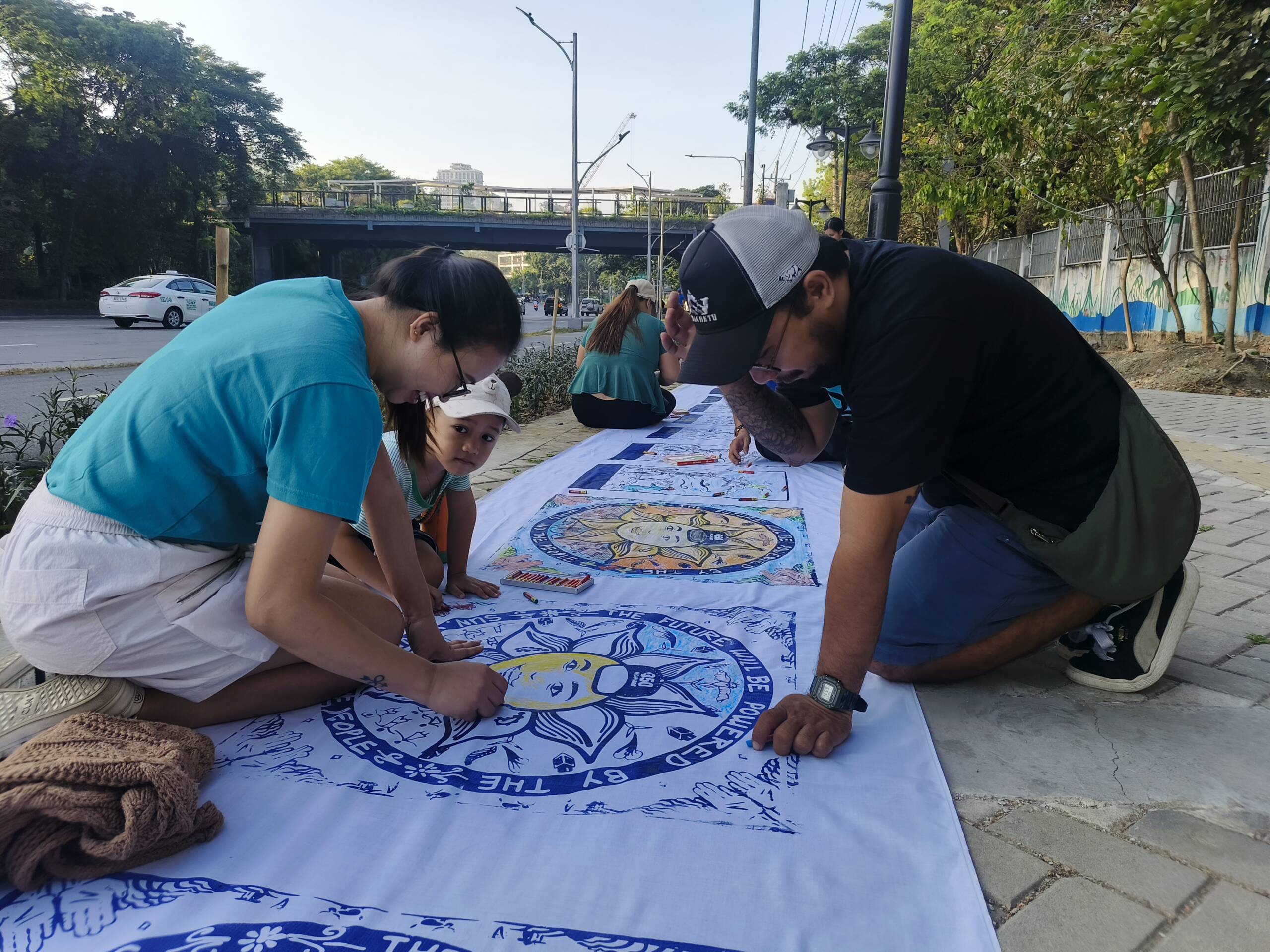
A vibrant blend of creativity and family bonding, where multiple generations—from curious children to engaged adults—gather around a shared canvas, not just to sketch mandalas of the sun, but to express a collective vision for a sustainable and safe future. Photo: Fread De Mesa
Half a world away, in Santa Marta, Colombia, something equally important is unfolding. The First Conference on Transitioning Away from Fossil Fuels is bringing together countries—many from the Global South—that are done waiting for permission. For years, the language of international climate agreements has edged forward, careful and qualified. Now there is a growing recognition that “just transition” cannot remain an abstraction. It has to become real—fast, fair, and funded in a way that acknowledges who has benefited most from the burning of coal, oil, and gas.
To understand where the energy transition is actually taking shape, you don’t start in conference halls. You start in the heart of urban poor communities through initiatives like BASECORE, where solar solutions are integrated into the very fabric of the city to ensure the transition leaves no one behind. You start in places like Casiguran, Aurora, where the local energy plan is being reimagined as a public good—locally rooted, shared collectively, and designed to be as resilient as the people who live there.
This is the broader vision of 350 Pilipinas: to change how we power our society by building local leadership and technical expertise. By empowering urban poor associations under the PhILSSA consortium to manage their own energy needs and collaborating with local governments to institutionalize fair policies, we are reclaiming the grid.
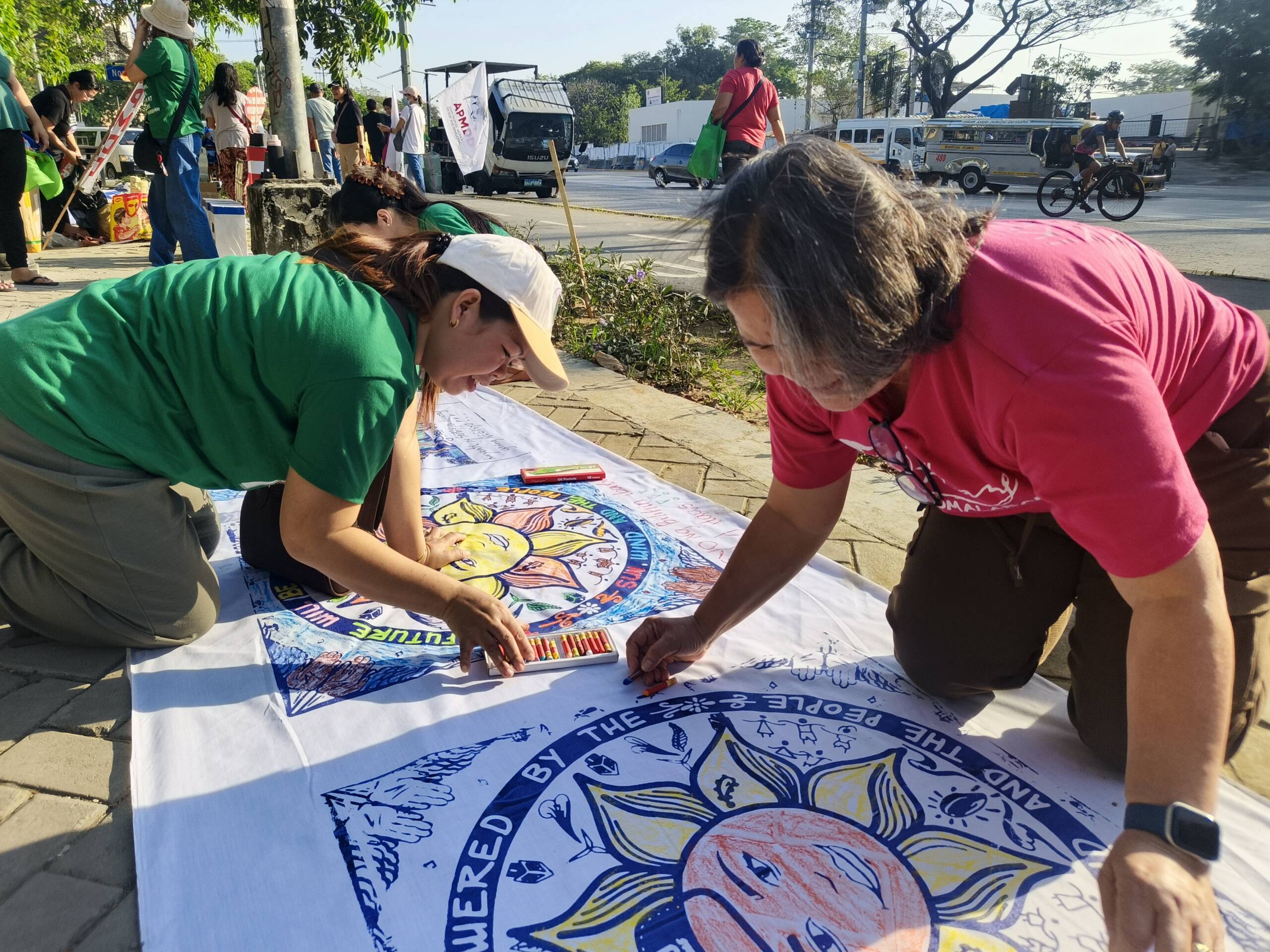
Mothers and women leaders of Oriang bring life to the banners together, adding their voices to a shared call for a greener, brighter world. Photo: Johnny Guarin
We see this work as a way of taking space—not just with our voices, but with the quiet clarity of action. Whether it is through protest marches and critical mass bike rides that reclaim the streets or community-managed solar arrays, we are proving that the systems powering our lives belong to us. We are catalyzing a movement to build collective power, leading the campaign for low-carbon cities through grassroots leadership. Together, we are drafting a roadmap for a future powered by the sun, the wind, and the people.
What’s emerging, if you step back far enough to see it, is less like a single movement and more like a vast, living network. It functions like the root systems of wild grasses or bamboo that spread horizontally beneath the soil, sending up new shoots in many different places at once.
There is no single trunk and no central command. Instead, there are vital, invisible connections: between an early morning march in Quezon City and a high-level policy discussion in Santa Marta; between a new bike lane carved out of a congested highway and a solar panel finally bringing light to a remote classroom. Each effort might seem small on its own, but because they are all linked at the roots, they form a collective force that is resilient, adaptive, and impossible to stop.
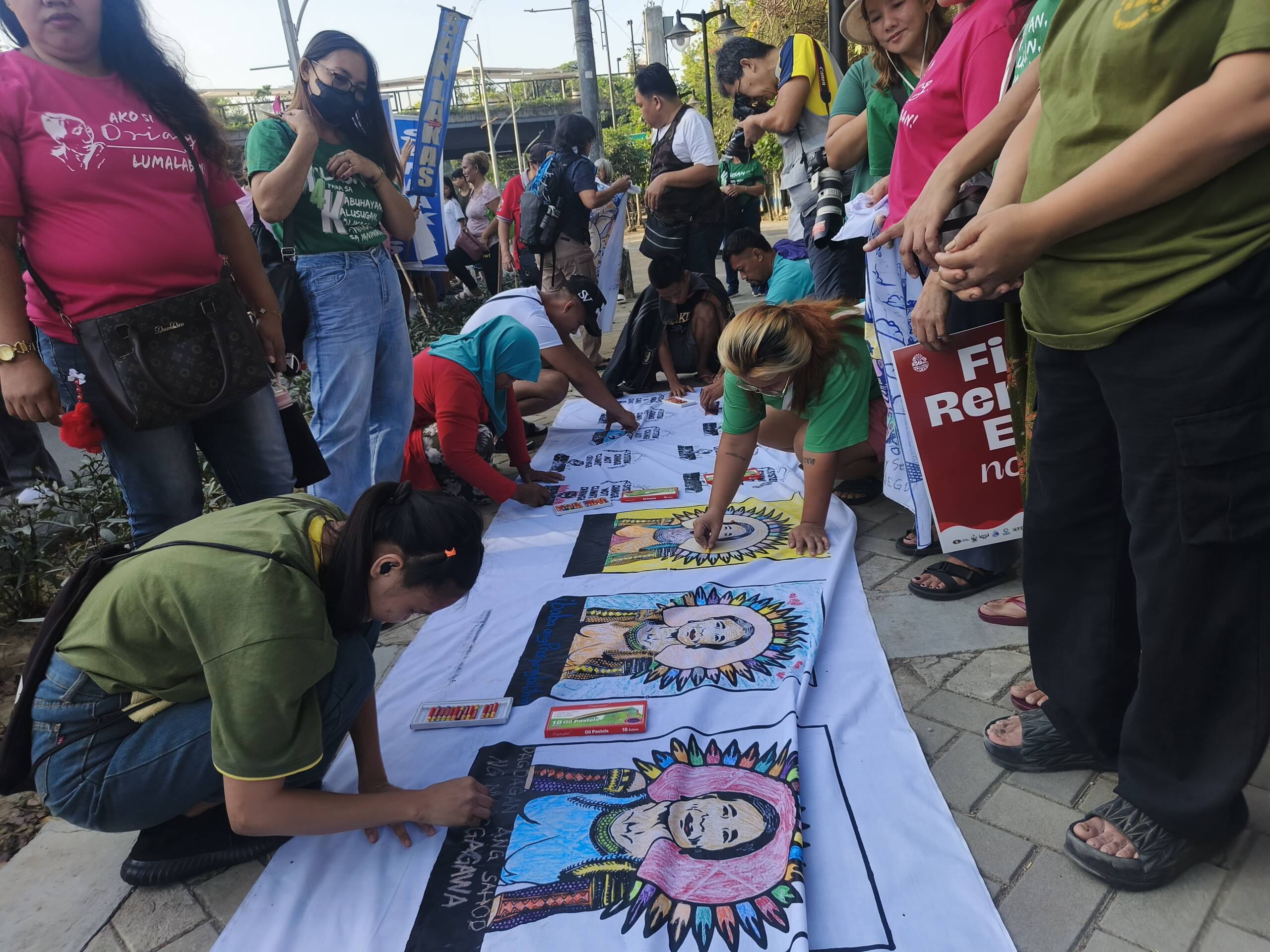
Vibrant, bold, and diverse in design, the finished artworks began as one shared cloth and are now a series of unique banners—different in form, yet unified in purpose. Each one reflects a collective vision for climate justice and people-powered change, carrying forward the same shared values in many distinct expressions. Photo: Johnny Guarin
This is what a real transition looks like—not a switch flipped somewhere far away, but a thousand local decisions, a thousand acts of resistance and creation, spreading across cities and fields, across urban settlements and rural villages. It’s messy, and it’s uneven, but it carries a kind of momentum that top-down systems rarely achieve. Because it isn’t imposed; it grows.
And that may be the most hopeful part of all. The future we talk about—a world powered by sun and wind, where communities have a real say in how energy is produced and shared—isn’t waiting somewhere ahead of us. It’s already here in fragments, in sketches, in early experiments. You could see it this morning in the streets of Manila, just as you can sense it gathering in Santa Marta.
The work now is to keep it growing, to connect those fragments, to let the roots spread.