
Metro Manila’s severe urban mobility crisis, characterized by crippling traffic congestion and inadequate public transportation, disproportionately affects students who must commute daily for their education. The current transport system is a significant barrier to their academic and personal lives, with long commute times hindering their routine. The PRFS offers a potential alternative that bypasses road traffic, providing a faster and more efficient travel option.
This study concentrated on the Guadalupe, PUP (Polytechnic University of the Philippines), and Escolta stations because these stations are situated in key areas with a high concentration of schools and universities. For instance, the PUP and Escolta stations are in proximity to major academic institutions, including the Polytechnic University of the Philippines, Colegio De San Juan De Letran, Mapua University, Lyceum of the Philippines University, and Pamantasang Lungsod ng Maynila. By targeting this group, the research can assess the PRFS’s viability as a main mode of transportation and as a sustainable solution for a large audience that is in urgent need of reliable transportation. Understanding the youth’s perception, experience, usage patterns, and additional needs can provide valuable insights for improving and expanding the PRFS to address the urban mobility challenges of Metro Manila.
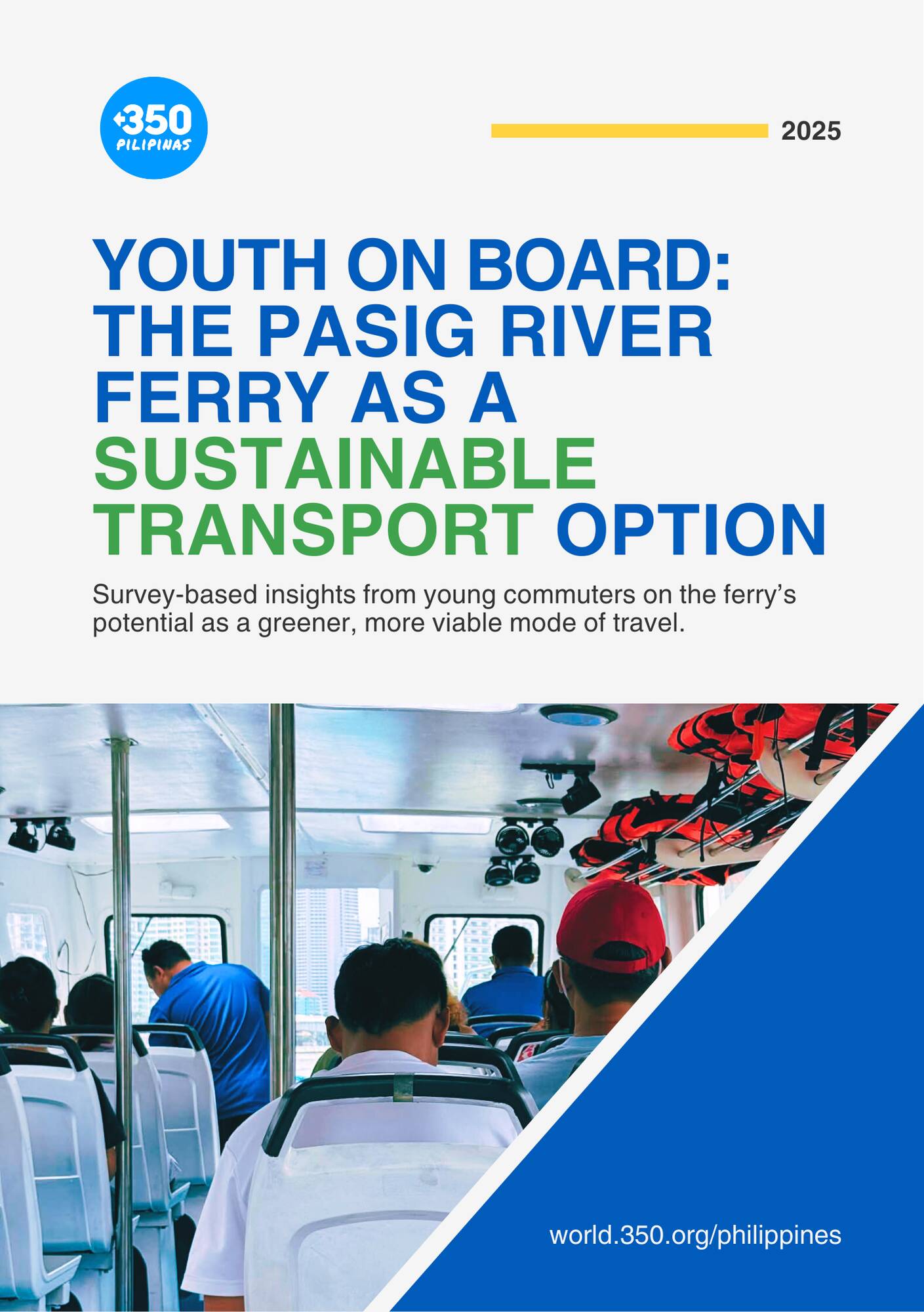
Survey-based insights from young commuters on the ferry’s potential as a greener, more viable mode of travel.
The Urban Mobility Challenge in Metro Manila
Metro Manila is grappling with one of the most severe urban mobility crises in the world. Once considered a leader in transportation innovation in Asia, boasting the Manila–Dagupan railway (1892) and one of the earliest electric streetcar systems in the region, the Philippines has since fallen behind its ASEAN neighbors in modern, sustainable mobility development.
Reviving the River: Progress and Risks
Historically a hub of life, trade, and transport, the Pasig River suffered decades of neglect and pollution. Recent efforts aim to restore its role as a functional mobility corridor:
- 2023: Creation of the Inter-Agency Council for the Pasig River Urban Development (IAC-PRUD).
- Pasig Bigyang Buhay Muli: A masterplan envisioning esplanades, walkways, bike lanes, parks, and vibrant riverside public spaces.
- PRFS Upgrades: New boats, improved stations, and stronger MMDA–DENR partnerships raised ridership to nearly 200,000 passengers in 2024.
- Planned ₱800-million investment: For dredging, new vessels, and 18 modern ferry terminals.
Yet challenges remain. The controversial Pasig River Expressway (PAREX) threatens environmental gains, heritage sites, and encourages more car use. Ongoing pollution, institutional fragmentation, and waste-management issues further complicate long-term revival efforts.
The controversy surrounding PAREX also underscores broader institutional and operational challenges for Pasig River rehabilitation. Since the dissolution of the Pasig River Rehabilitation Commission in 2019, the river’s stewardship has become fragmented across multiple agencies, complicating accountability, continuity of programs, and long-term planning. New initiatives such as the Pasig Bigyang Buhay Muli program, the Pasig River Ferry Convergence Program, and inter-agency collaborations under the IAC-PRUD depend heavily on sustained political will, adequate budget allocation, coordinated inter-agency action, and active community participation.
Youth at the Center of Sustainable Mobility
The youth occupy a critical position in shaping the future of transportation, climate action, and urban development in Metro Manila. As a demographic that is highly mobile, technologically adaptive, and deeply affected by the city’s dysfunctional transport systems, young people especially students experience firsthand the consequences of long commutes, unreliable public transit, and car-centric urban planning. Their daily journeys are not merely logistical challenges; they affect educational performance, mental well-being, financial stability, and opportunities for personal growth. In Metro Manila where students routinely spend hours stuck in traffic for trips that should take minutes, mobility becomes a barrier to equity rather than a pathway to social participation.
Youth Perceptions: Positive Potential, Low Awareness
A survey of 153 young commuters reveals strong interest but limited engagement with the PRFS. Key findings include:
- Positive perceptions, high neutrality: Over 60% see value in the ferry for sustainability, safety, and convenience, yet 30–35% remain neutral, highlighting a lack of awareness rather than opposition.
- Cultural appreciation: Nearly 65% recognize the ferry’s heritage value, though a third remain neutral, suggesting surface-level understanding.
- Promotion gaps: More than 65% have never seen ferry-related advertisements, and 35% are unaware that rides are free, a significant barrier for cost-sensitive students.
- Usage patterns: Over 85% are new users; 65% ride occasionally. Despite low habitual use, 78% reach destinations in under an hour, demonstrating competitive travel times.
Accessibility and service quality: Stations near PUP, Guadalupe, Lawton, and Escolta are convenient, but last-mile connectivity, lighting, signage, and PWD access need improvement.
Unlocking the Ferry’s Potential
To transition the PRFS from an occasional curiosity into a youth-friendly, sustainable transport option, the study recommends:
- Accelerate low-carbon mobility: Expand the PRFS to reduce traffic and emissions.
- Integrate into Metro Manila’s transport network: Recognize ferries as a formal transit tier alongside buses, jeepneys, and rail.
- Enhance multimodal connectivity: Link terminals with public transport, bike lanes, and pedestrian walkways.
- Launch campus-centered awareness campaigns: Reach students through schools, universities, and digital platforms.
- Maintain free or subsidized fares: Ensure affordability for students and youth.
- Expand routes and align schedules: Focus on university corridors and peak student hours.
- Strengthen river maintenance: Ongoing dredging, waste management, and cleanup programs.
- Engage youth in design and advocacy: Build participatory urbanism and mobility literacy.
- Highlight cultural value and climate benefits: Storytelling and in-transit education to reinforce heritage and environmental impact.
- Use the ferry as a living laboratory: Partner with universities for experiential learning and research projects.
Conclusion
Metro Manila’s mobility crisis demands bold, sustainable solutions. The Pasig River Ferry Service is uniquely positioned to deliver cleaner transport, faster commutes, and renewed life to the river. With improved connectivity, reliable operations, and youth-centered outreach, the PRFS can evolve into a central pillar of low-carbon mobility and a revived civic space for the next generation.