
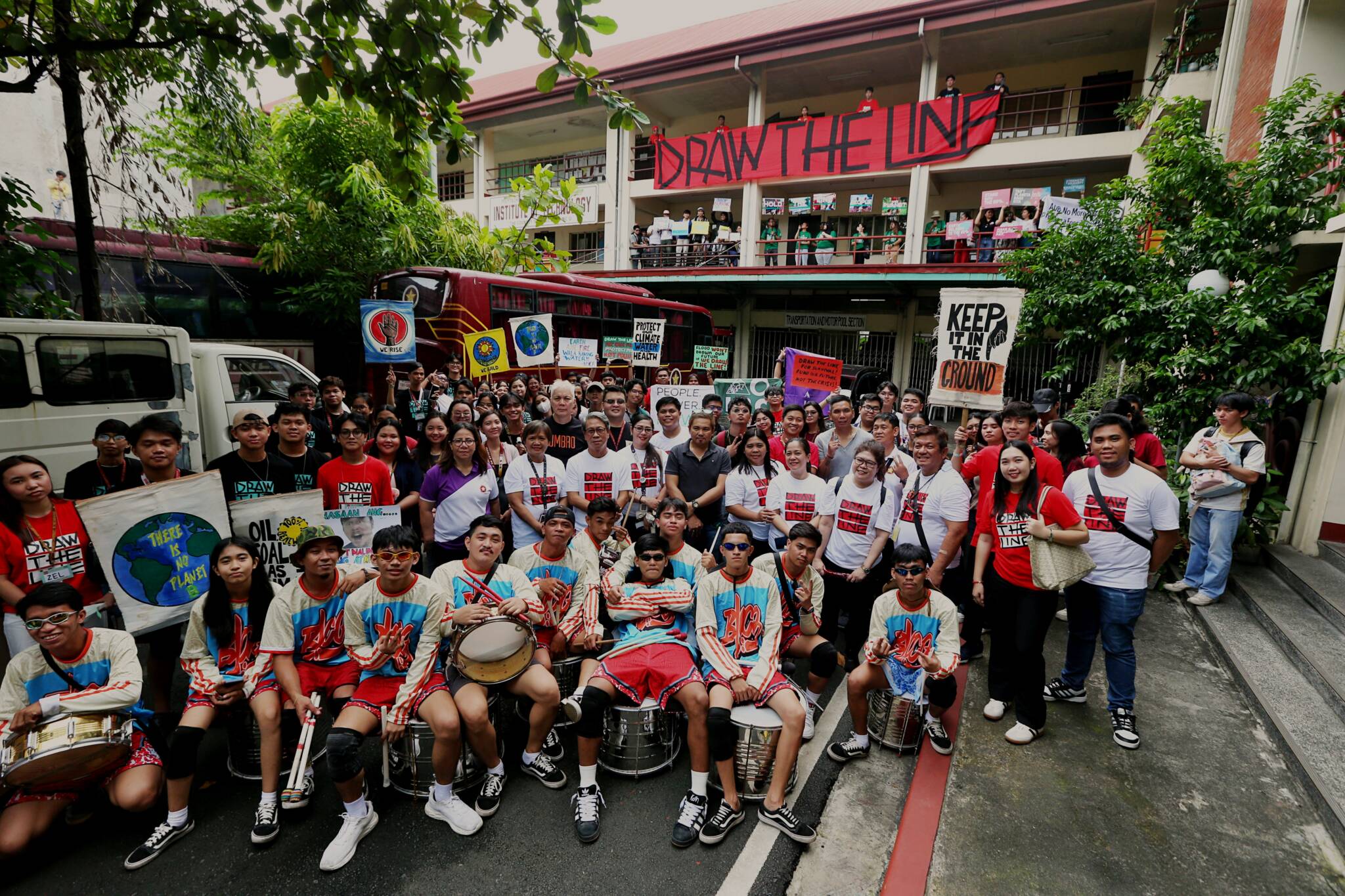
STA MESA, MANILA, PHILIPPINES, 19, SEPTEMBER, 2025 – Communities, youth, and civil society organizations gathered at the Polytechnic University of the Philippines (PUP) to call for people-centered climate solutions through the global campaign Draw the Line, ahead of the Global Day of Action for Climate Justice.
The Philippines is caught in the crossfire of two crises: the climate emergency and systemic corruption. Recent scandals have exposed ghost projects, anomalous contracts, and substandard infrastructure that have not only drained public coffers but also deepened the impacts of flooding and disasters. This corruption is climate injustice, diverting resources away from the people who need them most and locks communities into vulnerability.
“Advocating genuine climate solutions is both an act of defiance against extractive industries and a celebration of community power. Across the Philippines, communities are leading the way toward community-owned renewable energy, they are rising, mobilizing, and demanding accountability. We continue to call on financial institutions to stop funding destruction and start funding our future, prioritizing people and the planet over profit. Now is the moment to draw the line: between community-led solutions and exploitative false solutions, between climate justice and climate destruction.” Says Jawo Jayme, Lead Coordinator for Draw the Line Philippines
The three-part activity include a snake rally and the unfurling of a giant banner in front of the university, an array of exhibits showcasing community-led climate initiatives in rural and Indigenous Peoples (IP) communities, and student-led mobile charging project powered by photovoltaic technology. The Draw the Line concludes with a music festival featuring artists and cultural groups.
From September 19–21, simultaneous actions took place across the Philippines to build momentum toward COP30 in Brazil, calling on national leaders to redirect public financing to communities, divest from fossil fuels, and invest in renewable energy and sustainable systems. Draw the Line: Celebrate Community-Led and People-Centered Climate Solutions lifts up grassroots, youth, and community-led initiatives that prove another path is possible, where transparency, participation, and justice guide our climate response.
National Coordinator of 350 Pilipinas, Fread De Mesa underscored the relevance of the International Court of Justice Ruling. “2025 is a pivotal year for climate justice. Following the historic International Court of Justice ruling, the world stands at a turning point—where states are compelled to act, and people’s movements are emboldened to hold major polluters accountable.
We are drawing the line in a world trembling with the echoes of collapse, where inequality and ecological destruction are not accidents but the dividends of a system that has treated people and the planet as disposable”
From September 19–21, actions across the Philippines will join the global wave leading to COP30 in Brazil, demanding that leaders:
- Cut the line on corruption and fossil fuels. Redirect every peso from ghost projects and coal, gas, and oil into the hands of communities.
- Fund the future. Invest in renewable energy, resilient infrastructure, and sustainable systems that serve people, not profit.
- Deliver accountability and justice. End impunity for corrupt officials and ensure climate resources reach the communities most affected by disasters.
ABOUT THE ORGANIZERS:
- 350 Pilipinas – advocacy organization advancing climate action rooted in science and justice
- Polytechnic University of the Philippines-Institute of Technology – a public, non-sectarian, non-profit institution of higher education
- Participating organizations: The organizations include 350.org, 350.org Asia, Amnesty International, Asian Peoples’ Movement on Debt and Development, Consortium of Office Management and Information Technologists, Global Alliance for Incinerator Alternatives (GAIA) – Asia Pacific, Greenpeace Philippines, Health Care Without Harm – Southeast Asia, Human Rights and People Empowerment Center, Institute for Climate and Sustainable Cities, Kalayaan National High School, Lasallian Institute for the Environment, Legal Rights and Natural Resources Center, Lilok Foundation, LILAK: Purple Action for Indigenous Women’s Rights, Mobility Awards, NGO Forum on ADB, Oxfam Pilipinas, Panatang Luntian, Penuel School of Theology, Philippine Movement for Climate Justice, Popcycle, PUP Institute of Technology Student Council, PUP-SETS, Reboot Philippines Renewable Energy Transition Institute, 350 Pilipinas Bike Squad, and Sanlakas.
Creating and advocating genuine climate solutions is both an act of defiance against extractive industries and a celebration of community power. Across the Philippines, communities are leading the way toward community-owned renewable energy, they are rising, mobilizing, and hi demanding accountability. We continue to call on financial institutions to stop funding destruction and start funding our future, prioritizing people and the planet over profit. Now is the moment to draw the line: between community-led solutions and exploitative false solutions, between climate justice and climate destruction. This day is a testament on how organizations uniting across sectors, to campuses and youth showcasing their climate solutions through friendly competition, we see the power of collective action. Through art, music, we express our advocacies, build solidarity, and affirm that the future we demand is rooted in justice, powered by solutions, and fueled by community – Jawo Jayme, Draw the Line Philippines Coordinator
Fread De Mesa, National Coordinator of 350 Pilipinas
2025 is a pivotal year for climate justice. Following the historic International Court of Justice ruling, the world stands at a turning point—where states are compelled to act, and people’s movements are emboldened to hold major polluters accountable. We are drawing the line in a world trembling with the echoes of collapse, where inequality and ecological destruction are not accidents but the dividends of a system that has treated people and the planet as disposable. That system is now cracking, and in those fractures lies the invitation to reimagine economic development: one that thrives in a climate-challenged world, aligns action with justice, and empowers communities to own their renewable future.In the Philippines, we draw the line not only to resist, but to ignite change—turning the celebration of life and solidarity into an act both radical and emancipatory, and ensuring that justice powers the future we all deserve.
Norly Mercado, Regional Director of 350.org Asia
Political upheavals across Asia show how climate breakdown deepens inequalities and breeds social unrest. We draw the line on our leaders’ failure to deliver as ordinary people struggle with rising costs of living and deadly climate impacts.
Thousands across Asia are drawing the line, with protests and creative actions in Indonesia, Japan, Bangladesh, South Korea, Taiwan, Thailand and China. We are demanding big polluters to stop fossil fuel expansion and fulfil their climate obligations to nations least responsible for the crisis. We are asking governments to tax billionaires and polluters so that we can fund a renewable energy future powered by the people
Chuck Baclagon, Regional Finance Campaigner of 350.org Asia
To draw the line now is to say clearly: life, dignity, and this planet are not negotiable. The turmoil we see around us is not just chaos—it’s the bill coming due for centuries of extraction and injustice, and it’s a sign that the old system is breaking apart. But this is also about building momentum for what comes next. Ten years after the Paris Agreement was ratified, the world heads into COP in Brazil with stakes higher than ever. Nothing less than a fair, ambitious, and binding commitment—with real money on the table—is the bare minimum.
This is our chance to insist on something different. To resist what destroys us, and to fight for what sustains us. We draw the line not only against the polluters and profiteers, but toward a future where people and planet matter more than an economy hooked on business-as-usual; where courage and solidarity are the building blocks of survival. That’s the work, and it begins wherever we stand together.
Lot Felizco, Executive Director of Oxfam Pilipinas
Oxfam Pilipinas draws the line against inequality. Together with young Filipinos, frontline communities, and partners from civil society and the academe, we stand firm in the call to make rich polluters pay. This reflects the voices of the 84% of Filipinos who, in a global survey by Oxfam and Greenpeace this year, want polluting corporations held accountable for the environmental damages they caused.
Nazareth Del Pilar, Just Transitions Advocacy Officer of NGO Forum on ADB
This year marks the first decade of the Paris Agreement—a landmark accord that brought renewed hope in the face of the planetary crisis threatening both humanity and the environment. Asia, the most vulnerable region to the impacts of climate change, has seen a surge of investments in climate mitigation and adaptation. Multilateral Development Banks like the ADB and AIIB as ‘conduits of climate finance’ pledged to align their investment portfolios respectively to the Paris Agreement; but the very same banks derail their own commitments.
These MDBs drastically shifted the landscape of climate and energy investments, promoting false solutions that prolong the life of fossil fuel industries. These institutions have become complicit in enabling the corporate interests fueling the global ecological crisis. Now, we must draw the line. We must hold these financial institutions accountable for their dirty energy legacies. We must draw the line for true climate solutions: democratized, people-centered renewable energy systems. And we must draw the line for a just and equitable transition, one that prioritizes distributive and reparative justice for communities, workers, Indigenous peoples, women, LGBTQ+ individuals, and all marginalized sectors.
Lidy Nacpil, Coordinator of Asian Peoples’ Movement on Debt and Development (APMDD)
We are drawing the line against deceptive tactics led by rich nations and big corporations to perpetuate fossil fuel dominance and delay the equitable transition to a fossil free and healthy planet. We demand a complete coal phase out in Asia by 2035 and a rapid and just energy transition out of fossil fuels and to 100% renewable energy before 2050. We demand the full delivery of climate finance obligations of the Global North to the Global South for urgent climate action including Just Transition! This is a crucial part of their reparations for historical and continuing harms to our people.
Arturo Tahup, Director for Community Resilience of Institute for Climate and Sustainable Cities
The Draw the Line campaign provides a strong reminder that people and communities have the power to act on the climate crisis. None of the work that we are doing will matter if those in the frontlines are left behind. Local governments and vulnerable communities must always be at the center of climate action.
The energy transition can be accelerated in more energy-poor communities and off-grid islands by building locally managed and owned renewable energy systems that primarily benefit communities in terms of energy affordability and reliability, accessible and regular social services, and improvement of people’s lives and livelihoods. In Sulu-an and other energy-poor communities, the task at hand is empowering people to reclaim power for the people.
Leon Dulce, Campaign Support and Linkages Coordinator of Legal Rights and Natural Resources Center
The Philippines undermines its pursuit of a renewable energy transition if it allows coal mining to continue to expand and operate. In South Cotabato, coal mining operations linked to San Miguel Corporation have already excavated roughly 300 hectares of critical watershed areas, posing risks to reforestation sites and micro-grid solar villages of indigenous Taboli Manobo communities. Coal mining represents the worst driver of the climate crisis as it perpetuates not only the continued production and consumption of fossil fuel that causes global heating, but also destroys forest carbon sinks and worsens the flooding crisis.
Jepie Papa, Acting Section Director of Amnesty International Philippines
Climate change impacts our human rights in profound ways. But it does not impact all of us equally. Amnesty is urging states – particularly wealthy, high-emitting countries – to put people before profit and transition away from fossil fuel as soon as possible. We demand that environmental defenders have the right to protest and have their voices heard. We have also sounded the call on the need to massively scale up funding for those countries most at risk from climate change through the loss and damage fund and other means. True justice will include an end to the destruction of the planet, but also sufficient support to those whose lives have been most affected.
Ghillean Pranz Fegidero, Organizational Communications Specialist of Reboot Philippines Renewable Energy Transition Institute
Reboot Philippines draws the line against the investment in fossil fuels and the constant disregard of vulnerable communities in their participation in climate negotiations. International dialogues are nothing but words if they do not heed the call of the most vulnerable to the climate crisis. A just energy transition will be won or lost at a local level. We demand that world leaders recognize and involve the voices of communities, especially their vulnerable members, such as women, youth, LGBTQIA+ individuals, indigenous communities, persons with disabilities, and workers, before, during, and after the transition. “
Brex Arevalo, Climate and Anti-Incineration Campaigner of Global Alliance of Incinerator Alternatives (GAIA) For 25 years, GAIA has drawn the line against waste-to-energy incinerators and other false solutions to waste climate change. These do not make waste magically disappear, but instead transforms these into toxic ash, air pollution, and wastewater. The ongoing government flood control controversy in the Philippines today highlights other important aspects inextricably linked to false solutions – high risk of corruption, and burdens passed on to vulnerable communities.
A good example is happening as we speak in Smokey Mountain in Tondo where thousands of families are being forcefully evicted from their homes in preparation for a P26 billion waste-to-energy plant. Many of them come from a lineage of waste workers who have pioneered and exemplified people-centered climate and waste solutions for decades. We call on the government to respect their right to permanent housing and recognize their role as real waste champions, cease ongoing forceful evictions, and stop all waste-to-energy plans.
Francis Dela Cruz, Country Lead for Philippines of AktivAsia
We also need to draw the line between glorified victimhood and celebration of initiatives to alleviate the climate crisis. We need to shift apathy to action and move from problems to solutions.
Virginia Benosa-Llorin, Senior Climate Campaigner of Greenpeace Philippines
Our vulnerability to climate change is not just a result of extreme weather, but of systemic corruption. As we face increasingly destructive typhoons and floods, the funds meant to protect us, amounting to trillions of pesos, are pocketed by government officials, contractors, and their networks. Flood control is a critical part of climate adaptation, but corruption turns these vital projects into unfulfilled promises and hollow rhetorics that deepen the crisis instead of providing relief.
Filipinos, who have contributed the least to the climate crisis, are among the most gravely affected by its impacts. For centuries, rich nations of the Global North and fossil fuel corporations have polluted our planet, while our communities pay the highest price in lives, livelihoods, and ecosystems lost.
We recognize that the greed of corrupt officials, contractors, and fossil fuel corporations, who knowingly poison the planet for profit, endangers the lives of millions and stands to drown our most vulnerable in the devastation of floodwaters and abject poverty.
Donna Mae Ocmeja, Communications Manager of Health Care Without Harm Southeast Asia
The climate crisis is, at its core, a health crisis. For more than two decades, our organization has been mobilizing the healthcare sector and its communities across the region to take bold climate action. By standing with 350 Pilipinas and other allies in this cause, we reaffirm our commitment to uphold every Filipino’s right to health and a healthy environment—while advancing healthcare’s just transition away from fossil fuels.
##
Media Contact: Nadia Cruz +639770130207