
Jawo Jayme
Leaving the dense, humid sprawl of Metro Manila, the air cools as the road winds upward into the Sierra Madre. It is a striking irony that while the capital’s lights shimmer in the distance, many of the Indigenous communities protecting the mountains that safeguard the region’s water and ecosystems continue to live in near-total darkness. During a recent visit to Tanay, Rizal, I met with Teacher Irene of Paadelan E Denomagat, an alternative learning space dedicated to the Dumagat-Remontado people, to explore how solar power can move beyond being an urban “green luxury” and instead become a practical foundation for Indigenous energy sovereignty.
Teacher Irene and her sister, Teacher Diday, have helped build a vital sanctuary for a community of around 70–80 families who rely largely on subsistence farming, the production of cash crops such as turmeric, taro, and other vegetables, as well as seasonal honey harvesting. In this learning space, children are taught not only how to read and write but also how to navigate a rapidly changing world while remaining rooted in their culture. Yet when evening falls across the ancestral domain, the absence of reliable electricity limits what the school can offer. As she shared, access to basic social services remains scarce, making even a small solar installation more than a technical upgrade—it becomes a pathway toward strengthening both education and community resilience.
Supporting this transition is also a way of recognizing the longstanding role Indigenous communities play as frontline stewards of the environment. By protecting ancestral lands from extractive, fossil-fuel-dependent development, they have sustained ecosystems that benefit far beyond their territories. Expanding access to locally controlled renewable energy helps reinforce that stewardship by reducing dependence on costly and unreliable external fuel systems while enabling the learning space to function as a more dynamic educational hub. Reliable lighting and power can support digital learning tools, community workshops, and small livelihood activities such as turmeric powder making and honey processing, and disaster response, creating opportunities that extend well beyond the classroom.
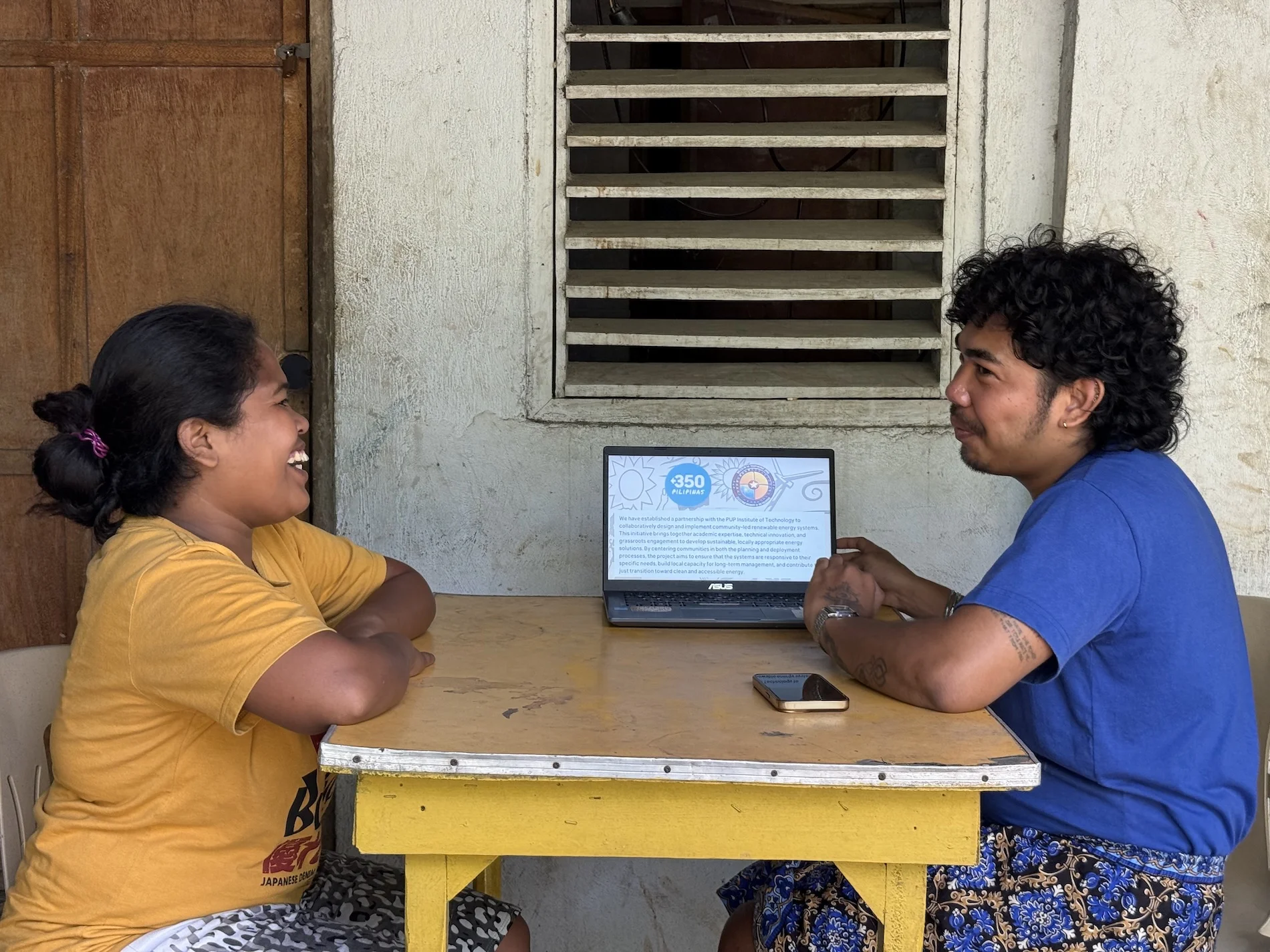
Energy sovereignty begins with shared vision. Jawo Jayme of 350 Pilipinas meets with Teacher Irene of Paadelan E Denomagat in Tanay, Rizal, exploring how renewable energy can power this learning space and help Indigenous communities shape their own sustainable future.
Photo: Chary delos Reyes
The experience in Tanay is a reminder that the energy transition must reach the peripheries if it is to be truly just. Solarizing only the more connected and affluent areas misses the deeper purpose of climate action. In places like Paadelan E Denomagat, renewable energy becomes a tool for self-determination—one that allows communities to strengthen education, sustain livelihoods, respond to climate disasters efficiently, and shape their own development pathways.
At the same time, efforts like these are part of something larger: the emergence of a movement for decarbonization that grows not from a single center, but across many communities at once. Like rhizomes—root systems that spread horizontally underground, sending out shoots in multiple directions rather than growing from a single trunk—this movement takes shape simultaneously in cities and fields, in crowded urban settlements and remote rural villages, wherever people are building locally grounded solutions to fossil-fuel dependence. Each community solar initiative, each learning space powered by renewable energy, and each locally led transition effort becomes another node in a shared network of action. Together, they form the living infrastructure of a people-powered transition—one that is adaptive, interconnected, and capable of reshaping the country’s energy future from the ground up.