
The Bocaue, Bulacan-based Dr. Yanga’s Colleges, Inc. (DYCI) is taking giant steps towards choosing cleaner and more affordable energy to power its campuses.
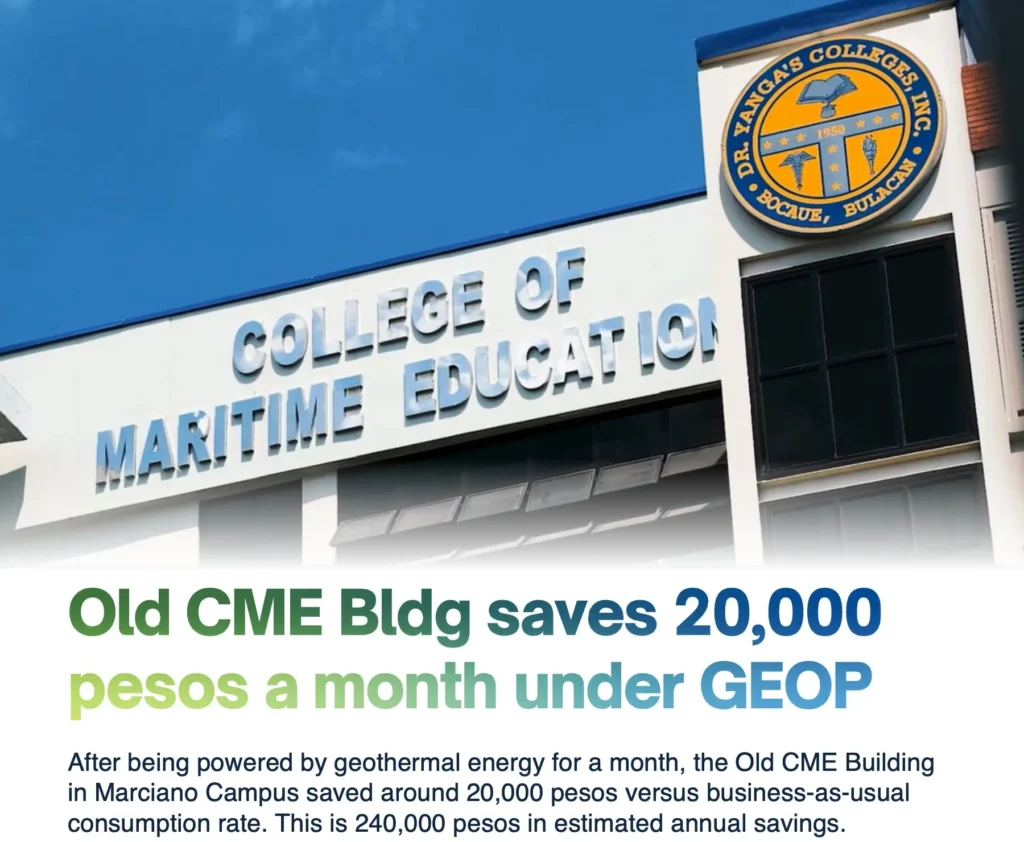
As of October 26, the old College of Maritime Education (CME) Building of DYCI’s Marciano Campus runs purely from geothermal energy thanks to the Green Energy Option Program (GEOP), with three more buildings set to make the big switch next year.
After one month being powered by 100% renewables, the Old CME Building was estimated to have saved around ₱20,000 versus the business-as-usual energy consumption rate.
DYCI had already made its first steps toward sustainability in 2022, when it installed solar panels across its Basic Education Department buildings. But with over 12,000 students across two campuses from grade school to college this school year, its management anticipated the rise of power costs.
“It’s very easy to get the support of School President Michael S. Yanga who values sustainability for the future of the Institution. It was also a timely problem because we have hit record-high energy consumption levels and costs, which was considered as a risk for raising tuition costs and we do not want that to happen,” Tigno said.
But first, what is GEOP?
The Green Energy Option Program is among the mechanisms created under the Renewable Energy Act of 2008 to increase the uptake of solar, wind, hydro, and geothermal power, among others.
Under GEOP, consumers with an average monthly peak demand of at least 100 kilowatts for the past year, or an estimated monthly electricity bill of at least PHP 190,000, are qualified to source their power completely from renewable energy suppliers.
DYCI and other potential GEOP end-users can save on electricity bills because they can lock in more competitive rates and enjoy zero Value Added Tax (VAT) on generation charges. In a simulation ran by the DYCI Office for Sustainability, the college’s switch to GEOP may bring 12 to 13 percent (%) savings from energy costs.
In a survey published last year by The Climate Reality Project Philippines, most of the 36 surveyed GEOP end-users secured electricity rates between four to five pesos and enjoyed a 20 percent reduction in electricity costs immediately upon switching. This translated to monthly savings on generation cost averaging PHP 355,000 per meter. They collectively saved PHP 71.7 million since 2021 and reduced carbon emissions by an average of 79%, or at least 38.9 million kilograms of carbon dioxide equivalent.
Most of the country’s energy comes from fossil fuels, which contribute to global warming. Fossil fuel sources such as coal, oil and gas are also mostly imported, making our electricity rates among the most expensive in Southeast Asia. On the other hand, renewable energy sources are abundant in the country. No wonder the Department of Energy is targeting an increase of renewables in the power generation mix, from a 22.3% share as of 2023 to 35% by 2030 and 50% by 2050.
The potential savings, coupled with the promise of sustainability, made DYCI eager to learn more about GEOP from 350 Pilipinas, which supports schools and other institutions in enrolling to the program. Representatives from both sides first met in November 2024 to explore GEOP further, and in May of this year, they had their first face-to-face meeting with Mike Panopio, First Gen Corporation’s power marketing officer.
Panopio stressed that there were no upfront costs aside from a security deposit and that Meralco will continue to distribute the electricity to DYCI’s campuses using their existing power lines.
The electricity now powering the Old CME Building is being supplied by the Bicol Region’s Bac-Man Geothermal Power Plant, managed by a subsidiary of the Lopez-owned First Gen.
“GEOP is a cost-effective measure in our aim to transition to renewable energy. Our dream is to become a carbon-neutral institution by 2030, and thanks to GEOP, we might be able to make it happen even earlier,” Tigno said.
“But more than the cost savings, DYCI will be able to offset carbon emissions, thus setting an example for how academic institutions can help secure the future of the Filipino youth by breaking free from fossil fuels that harm the planet,” he added.
Ogie Atadero, the 350 Pilipinas campaigner who helped DYCI switch to GEOP over the last months, said that while the program was a game-changer, the actual process can still be improved.
“GEOP is a good place to begin. It’s how we start to decarbonize our power systems—not just to do our share in cutting global emissions, but to build an energy future that’s resilient, self-reliant, and fit for a warming world. A future where growth isn’t held hostage to imported fuel,” he said.
“But potential only matters if we make it real. GEOP can be more than a promising start; it can be a turning point. To get there, the Department of Energy must make the program work better—streamline the process, make the rules clearer, and ensure that supply can actually meet the growing demand. If we do that, GEOP could become the spark that helps power the country’s transition to clean energy—and bring the net-zero goal a little closer to reach,” Atadero added.