
President Ferdinand Marcos Jr.’s fifth State of the Nation Address (SONA) comes at a moment as the country confronts the escalating impacts of the climate crisis, increasing energy insecurity, and persistent transport challenges.
As 350 Pilipinas reflect on the President’s fifth SONA, we reiterate implemented policies and investments that prioritize climate action and public welfare to (1) ensuring equitable access to renewable energy, (2) expanding sustainable and accessible transport systems, (3) accelerating the country’s transition away from fossil fuels, and (4) institutionalizing policies and initiatives that place people and the public interest above profit.
National Coordinator Fread De Mesa emphasized the need to address the root causes that keep our communities trapped in crisis:
“We need to attack this problem at the root. Stop dumping money into dirty, centralized grids and reckless shortcuts. Put those resources where they actually belong: real, community-led clean energy that regular people actually control and benefit from.”
“It’s easy enough for the President to drop buzzwords like ‘renewable energy’ and ‘climate resilience’ during the SONA. And yes, calling for an immediate amendment to EPIRA to scrap system loss charges and their accompanying VAT is a long-overdue step—consumers shouldn’t have been paying for power distribution losses in the first place. But let’s be honest with ourselves here: trimming a few lines off our monthly power bills won’t hold back floodwaters, protect our crops, or solve the deeper energy crisis.
Teachers and students are forced out of classrooms that are no longer safe or conducive to learning, while our farmers bear the brunt of destroyed harvests and rising costs that threaten national food security. Ordinary families are getting crushed day in and day out—wading through flooded streets and struggling to pay electric bills that keep climbing. To make matters worse, look at what’s actually being pushed behind the scenes—incinerators rebranded as ‘waste-to-energy’ and dangerous pipe dreams like nuclear power. Scrapping system loss charges while doubling down on toxic garbage burning and high-risk nuclear projects completely contradicts any claim of progress. It’s just swapping one environmental disaster for another while tying us up in decades of debt.
EPIRA reform must go far beyond patching up billing rules; it needs to completely dismantle our reliance on fossil fuels. Handing out relief packs after a storm passes isn’t climate action. We need to attack this problem at the root. Stop dumping money into dirty, centralized grids and reckless shortcuts. Put those resources where they actually belong: real, community-led clean energy that regular people actually control and benefit from.
The climate crisis is already happening right outside our windows. No more delays, no more half-measures.
Energy
Even in his previous SONA, President Marcos acknowledged rising electricity prices and recognized the importance of expanding “clean energy.” While the government’s recognition of clean energy is welcome, it must clearly define what qualifies as clean energy.
Rooftop solar, in particular, still has significant untapped potential.
Unlocking the rooftop solar means that the administration needs real reforms: remove VAT and import tariffs on solar equipment, improve net metering, simplify permitting, digitize interconnection, and expand low-cost financing.

The Sayang Ang Araw Campaign called for accessible and affordable solar energy for Filipinos. Photo: Leo M. Sabangan II
These are not flashy measures, but they are the ones that change daily life. Centralized power plants take years; rooftop solar can be installed in weeks. Every roof that generates its own power helps ease pressure on the grid and cuts one of the biggest monthly expenses for families.
Mechanisms to expand renewable energy access already exist. The tools are available under the Renewable Energy Act, including the Green Energy Option Program, which allows institutions to directly source renewable electricity. The challenge now is ensuring that more consumers can benefit from these mechanisms. If Marcos Jr. is citing the need to fast-track the Sariling Kuryente Act, these measures must also address existing barriers to renewable energy access.
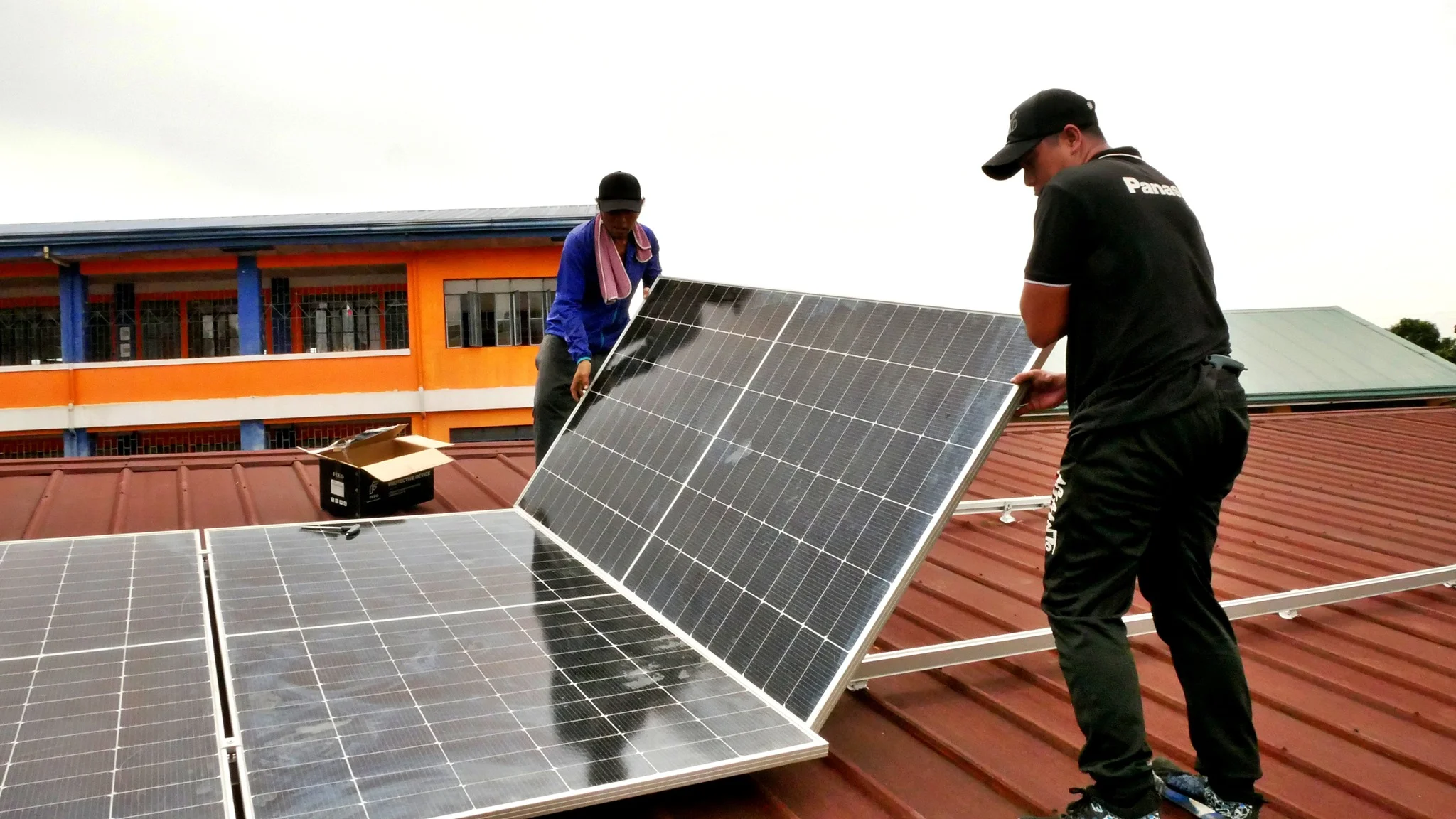
The case for rooftop solar is even stronger after the early 2026 fuel shock, triggered by the US Israel war on Iran, exposed the Philippines’ continued dependence and continued demand for imported fossil fuels. Yielding an increase in fuel and electricity prices, At the same time, public support is clearly moving in the opposite direction: a Pulse Asia survey found that 97 percent of Filipinos are concerned about the country’s energy situation, 77 percent recognize continued dependence on imported fossil fuels, and 66 percent see renewable energy as the best long-term solution. Affordable rooftop solar stood out as the top priority, with upfront costs still the biggest barrier.
If the government wants to meet its goal of reaching one million more households with solar by 2028, it must remove the barriers that keep people out.
Marcos Jr.’s SONA repeatedly reinforced waste-to-energy (WTE) and hydrogen production as solutions to the energy crisis and as measures to lower electricity prices. However, the administration’s push to sign 14 petroleum service contracts, four of which are for hydrogen, added increased risks to communities. His remarks on these projects being the most contracts awarded in a single term and revisiting nuclear energy further heightens both environment and social impacts, despite his view as a way to bolster energy security and affordability.
The country must take a decisive turn away from mistaking costly false solutions for real progress. Nuclear power carries major risks, deep import dependence, and could strain the country’s existing grid infrastructure. Meanwhile, WTE is essentially incineration repackaged as clean energy and cannot deliver utility-scale power. Neither provides a fast, fair, or truly local path to energy independence.
Electrification should not deepen dependence on imported fuels or environmentally destructive energy systems. It should accelerate decarbonization while improving energy access, affordability, and local energy independence.
Community-owned renewable energy projects continue to demonstrate that clean energy can also be equitable and democratic. Empowering local governments and communities to generate and manage renewable energy strengthens climate resilience while ensuring that the benefits of the energy transition are broadly shared.
The path forward is clear: energy transition should lower costs, reduce dependence on imports, and put power back in the hands of communities.
Clean Air and Sustainable Transport
The ongoing transport crisis in the Philippines underscores the urgent need to reduce dependence on fossil fuels and pivot toward sustainable transport. Following the 2026 fuel shock, petrol prices peaked at ₱120 per liter, drastically inflating travel costs and disrupting the movement of people and goods due to the nation’s heavy reliance on imported oil.
In response, the national government adopted a short-term approach by continuing to import fossil fuels while offering temporary measures: targeted cash assistance for public transport operators, a ₱10-per-liter gas subsidy for jeepneys and Utility Vehicles (UVs), temporary fare discounts, Libreng Sakay (free rides), and service contracting. While these measures provided immediate relief, it must transcend to a lasting solution that addresses growing demands on improvement of public transport fleets and systems that encourage use of active mobility.
Additionally, public demand for sustainable mobility is overwhelming. A recent pulse Asia survey shows that 94% of Filipinos support increased government investment in protected bicycle lanes and pedestrian infrastructure, while 93% favor expanding dedicated public transport lanes to reduce traffic congestion.
This shift is critical for both the economy and the environment. In 2020, the transport sector accounted for 22.8% of the country’s greenhouse gas emissions. Significantly reducing these emissions requires sustained investment in public transport, active mobility, and integrated urban planning that supports seamless inter-city travel.
Despite strong public backing, national funding for active transport has sharply declined—dropping from ₱2 billion in 2022 to ₱105 million in 2026. This allocation falls far short of what is needed to build safe, accessible infrastructure for the millions of Filipinos who rely on walking, cycling, and public transit daily.
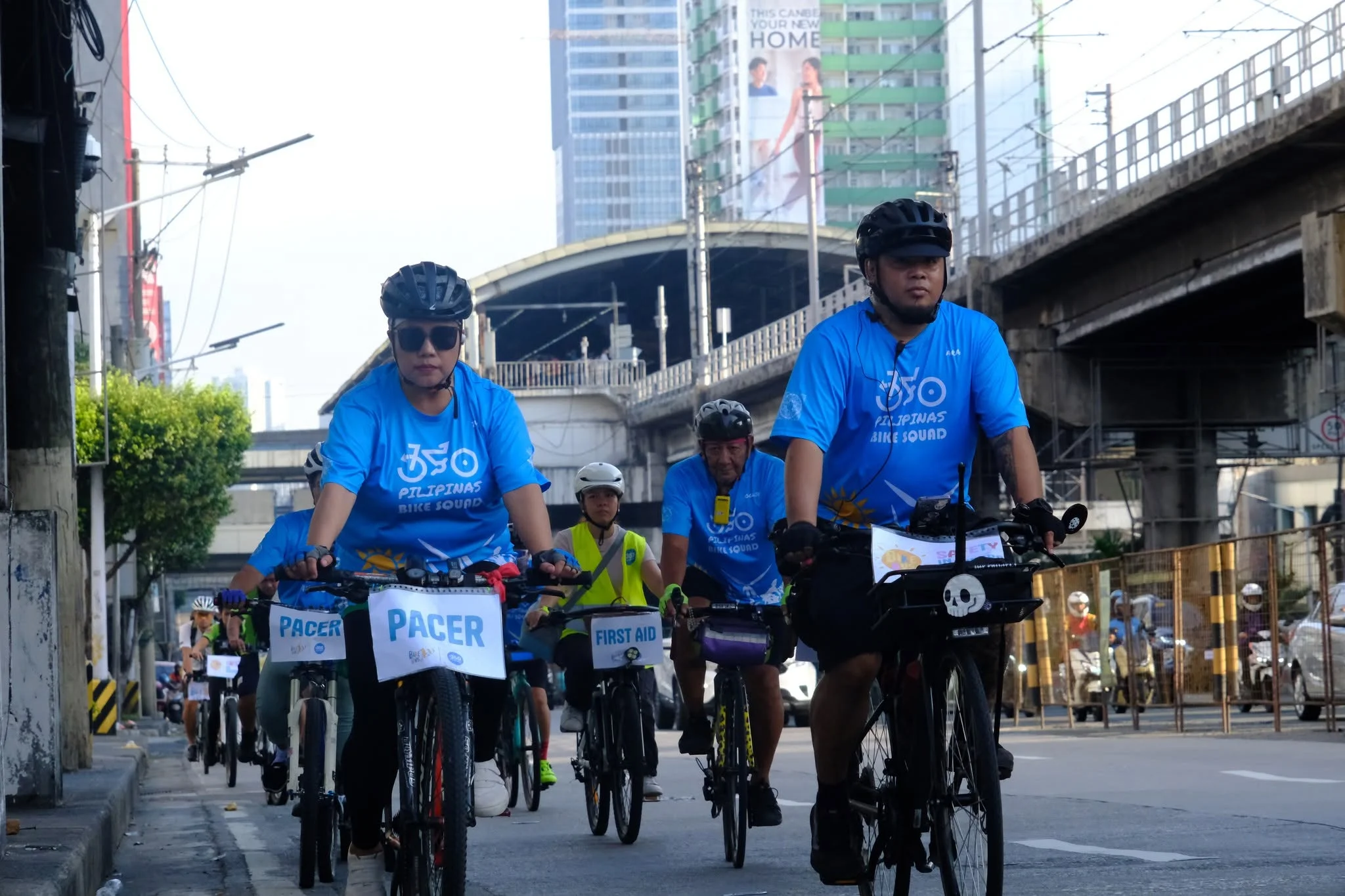
Bike Bus along EDSA are among the “soft” infrastructures piloted to support active mobility Photo: Nadia Cruz
The Marcos administration continued its push for electric vehicle adoption as a central pillar of its transport strategy. The government envisions electric vehicles comprising up to 50% of total road transport, a goal supported by extending zero-tariff policies on imported EVs and components through 2028. However, much like the broader energy sector, the recent surge in petroleum prices exposed the inherent economic vulnerability of relying on foreign oil. The challenge is to shift to electric vehicle fleets that must be paired with a clean grid powered directly by renewable energy sources.
In response, 350 Pilipinas calls on the government to substantially increase investment in active transport and public mobility networks. Closing this infrastructure gap requires both financial commitment and institutional reforms that prioritize safe, reliable, and interconnected systems.
“Investing in active mobility and efficient public transport reduces dependence on imported fuel, improves air quality, lowers greenhouse gas emissions, and delivers more equitable mobility for Filipino commuters.”
“Expanding sustainable transport is not only a climate imperative but also an economic and public health necessity,” said Jheny Dabu, Sustainable Transport Campaigner for 350 Pilipinas. “Investing in active mobility and efficient public transport reduces dependence on imported fuel, improves air quality, lowers greenhouse gas emissions, and delivers more equitable mobility for Filipino commuters.”
As energy and transport demand rises, the country is pushed deeper into creeping pollution and exacerbated climate impacts, all while worsening air pollution, endangering public health, and driving greenhouse gas emissions that fuel the crisis . These costs are not absorbed by corporations, they are passed directly on to consumers. Households continue to bear the burden of high electricity rates, and public transport fares and costs, exposing a system where risk is socialized but profits remain privatized.
Compounding this issue are persistent structural challenges: dependence on imported fuels, unstable electricity pricing, weak enforcement of environmental and health standards, slow renewable energy expansion, and unclear long-term coal policies. The impacts are severe and immediate. Emissions from coal-fired power plants and ICE Vehicles are reportedly linked to increased cases of respiratory and cardiovascular diseases, resulting in higher healthcare costs and lost productivity across communities.
In light of these challenges, we call for urgent and decisive action:
-Accelerate the deployment of renewable energy and energy storage
-Improve grid infrastructure and system flexibility
-Uphold and reinforce the coal moratorium—without loopholes or exemptions
-Protect and enable community-led renewable energy initiatives
-Develop the National Active Transport Master Plan*
-Fast track the amendments to our air quality standards and Air Quality Control and Action Plan
Climate action must move beyond policy announcements and become deeply embedded in national development. The Philippines’ energy and transport policies must strengthen resilience, expand public access to clean technologies, and ensure a low-carbon transition that is equitable, inclusive, and centered on people over profit. In response, 350 Pilipinas calls on the government to substantially increase investment in active transport and public mobility networks for commuters and pedestrians. Closing this infrastructure gap requires both financial commitment and institutional reforms that prioritize safe, reliable, and interconnected systems.