SCIENCE
Rapid Arctic warming is thawing carbon-rich permafrost, releasing
greenhouse gases that accelerate climate change. Despite the importance
of this feedback, permafrost-enabled global-scale models simulate only
gradual, top-down thickening of the seasonally-thawed soil. This ignores
abrupt permafrost thaw and intensifying fire regimes that combust soil
carbon and further accelerate thaw. Our model suggests that including permafrost thaw and
fire-related carbon emissions reduces the remaining allowable carbon
budgets from 2025 onward by 25 % ± 12 % for avoiding 1.5 °C and 17 % ± 7
% for avoiding 2.0 °C, relative to simulations without these processes.
Accounting for these additional emissions is critical for setting
emissions reduction targets aligned with the Paris Agreement.
GREENING.
- On January 1, California’s new 2025 Energy Code went into effect, increasing energy efficiency requirements in all forms of housing and strongly encouraging heat pumps. The code uses energy use “budgets” for buildings, requiring buildings to conform to a cap on total building energy use. Buildings built or substantially renovated after January 1 will be required to conform to the new code. California’s new code is projected to save residents an estimated $4.8 billion in energy costs over 40 years, and eliminate approximately 4 million metric tons of GHG emissions. Buildings in California account for 25% of the state’s emissions.
- With strong bipartisan support Congress passes bill to fund U.S. science agencies, rebuffing Trump’s requested cuts HERE. Congress voted to provide billions more to NASA, NOAA and the National Science Foundation than the president had asked for. If the spending package is signed into law, NOAA and NASA will receive $1.67 and $5.63 billion more than was proposed in the administration’s budget request, and programs slated for elimination, like NASA’s satellite program, will actually get a funding boost.
- Ever heard of Moment Energy? This small but mighty startup is converting used EV batteries into storage systems — and now, with millions of dollars of funding, they’re on track to build the first-ever “second-life battery gigafactory” in America. It’s a quintessential win-win, giving old, but usable technology a new lease on life and keeping hazardous materials out of our landfills HERE. [Thanks to Elders Climate Action for above two items.]
- European countries plan to sign a pact today committing themselves to building 100 GW of offshore wind power. (Reuters)
- EU sales of fully electric cars beat gasoline-powered car sales for the first time in December. (Reuters)
- A Colorado council of local governments plans to spend $200 million in federal clean energy funding on an effort to expand low-income residents’ access to electric heat pumps and efficiency upgrades. (Colorado Sun)
- A court in the Hague has ruled that the Dutch government “discriminated against people in one of its most vulnerable territories” by not helping them to adapt to climate change, reported the Guardian. The court ordered the Dutch government to set binding targets within 18 months to cut greenhouse gas emissions in line with the Paris Agreement, according to the Associated Press.
- Climate startup Vaulted Deep proposes a project in northeastern Colorado that would inject methane-rich cattle feedlot waste underground as a carbon capture and storage strategy. (CPR) [Or we could just eat less meat and milk – or both.]
DARK AGE CLIMATE POLITICS
- Tuesday January 27: The US officially exits the Paris Agreement today. It’s the second time President Donald Trump has pulled out of the pact that commits almost 200 countries to keep global warming to no more than 2C (3.6F), and ideally 1.5C, above pre-industrial levels.
- Trump’s Pick to Lead the Federal Reserve Could Steer Bank Away From Climate Change. Kevin Warsh has criticized central banks’ forays into climate change. Some activists and Democrats say the Fed hasn’t done enough. The fight over control of the Federal Reserve has revolved around interest rates and inflation, but President Donald Trump’s choice to be the bank’s next chair could sway how the agency assesses climate risks, too.
- California files a lawsuit seeking to overturn the Trump administration’s approval of Sable Offshore’s contested proposal to restart two oil pipelines along the state’s coast, saying the “federal government has no right to usurp California’s regulatory authority.” (Associated Press)
- New York Governor Kathy Hochul is going all in on nuclear power. She started off last year at the helm of a new multi-state alliance working on building more reactors. Over the summer, she directed the state-owned power authority to oversee construction of New York’s first new reactor since the 1980s. More recently, she inked a deal with Ontario to work together on building new plants and expanded her target fivefold to 5 gigawatts of new atomic energy in the state. Now she’s backed something a little more traditional but no less important. Last week, the state’s utility regulators extended subsidies for existing nuclear plants by another two decades in hopes of keeping aging reactors open until at least 2049.
- A deal with China will see Canada ease tariffs on Chinese electric vehicles that it imposed in tandem with the US in 2024. In exchange, China will lower retaliatory tariffs on key Canadian agricultural products. With the lower EV tariffs, approximately 10% of Canada’s electric vehicle sales are now expected to go to Chinese automakers, said Vivek Astvansh, a business professor at McGill University in Montreal.
- A US judge on Friday declared the Energy Department violated federal law when it brought on a group of five researchers who met in secret last year to produce a report downplaying the severity of climate change. The Environmental Defense Fund and Union of Concerned Scientists argued in their lawsuit that the team of researchers, dubbed the Climate Working Group, was an advisory committee that’s legally required to hold open meetings, provide open records, and maintain balance and influence in their work under federal law. US District Judge William Young concurred, saying the group was “not exempt” from the law.
Keep on taking action!
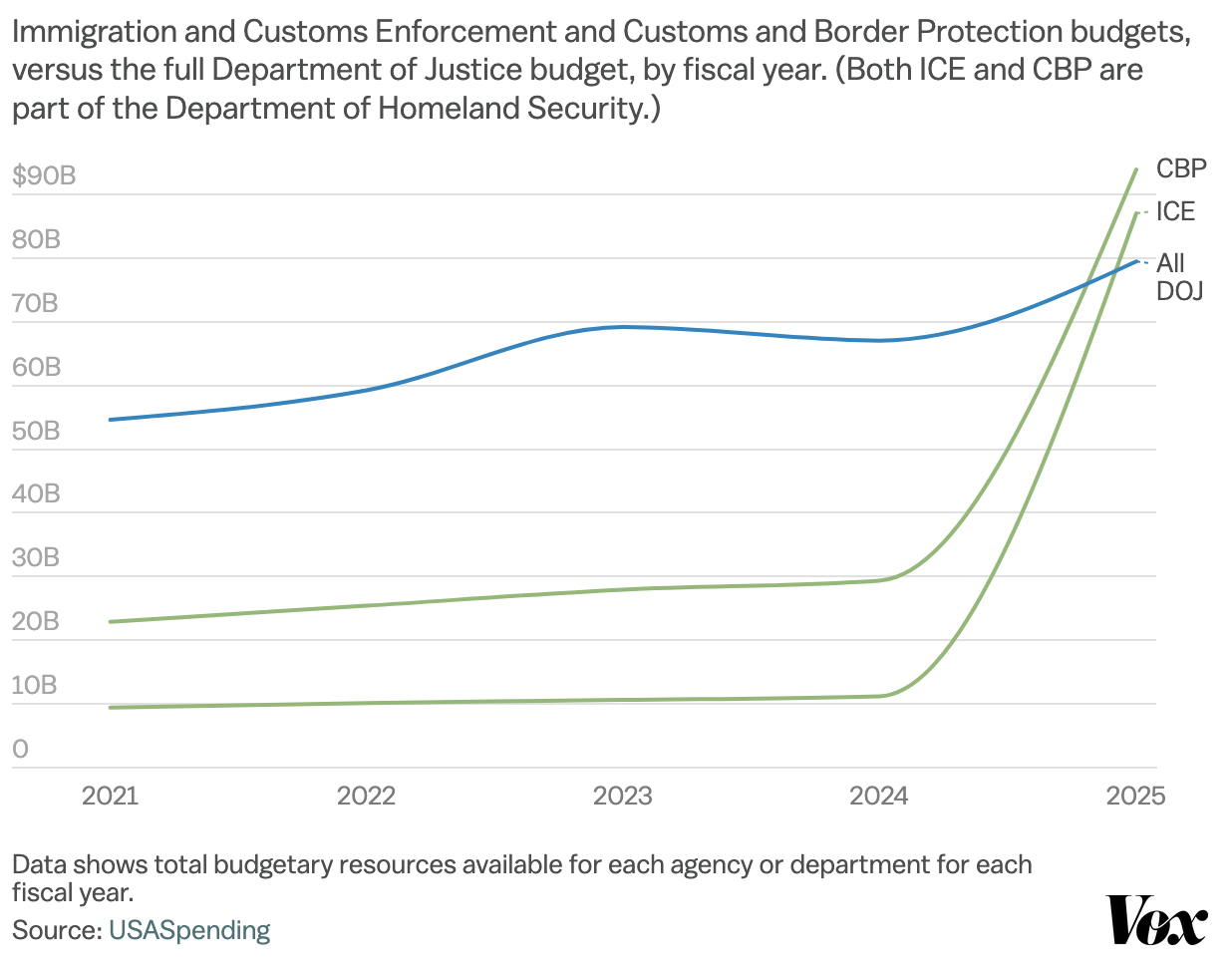
There have been several days of direct action against ICE and authoritarianism this month. We need to settle in for the long haul, which means several days a month of direct action against outrages of the Trump administration for the foreseeable future. ICE and Customs and Border Protection have been turned into a secret police, similar to the Gestapo or Stasi. Here is a measure of how much we are going to have to raise our participation in democratic actions. Each of these two lawless groups of masked, untrained, often white supremacist or Nazi ideologues, now has a bigger budget that all of the Department of Justice programs.
See you at the Courthouse in Eureka!