The LookOut is a monthly digest of climate-related issues and events taking place in Humboldt County.
A new nature preserve, the ‘O Rew Redwoods Gateway, opens to the public on August 1. This beautiful place in the redwoods offers hiking, biking, picnicking, and viewing wildlife opportunities. After thirteen years of restoration work, it is already home to endangered coho salmon and great blue herons as well as bears, elk, condors and many other species. The presence of belted kingfishers, in particular, testifies to the healthy water quality of the creek.
Located on Yurok ancestral lands, the 125 acres were hard used for many years as a lumber mill (picture twenty acres of pavement) and pasture lands between Orick and Redwood National and State Parks. After Save the Redwoods League purchased the site in 2013, a consortium of public agencies, SRL, and the Yurok tribe have worked to return the land and a degraded stretch of Prairie Creek to its unspoiled condition. The Gateway is now owned and managed once again by the Yurok Tribe.
Tribal Chairman Joseph L. James noted that the benefits of this land-back deal will also be economically good for the town of Orick and other neighboring communities because of the visitors it will attract to the area.
The ‘O Rew is only one of the many restoration projects the Yurok Tribe is engaging in. Click here to see an amazing list of projects involving restoring rivers, condors, renewable energy for tribal elders, social services, new energy efficient homes, a farm for youth, a training center in Orick for the “new generation of environmental stewards” and even more.
California’s Climate Bond, passed in 2024 as Proposition 4, has infused $12.4 million into the Great Redwood Trail. According to the GRT Master Plan, three segments of the trail in Humboldt county are next to be designed and constructed. They include a 7.7 Loleta segment, 4.2 miles between Fortuna and Fernbridge, and 5.2 miles between McCann and Founders Grove.
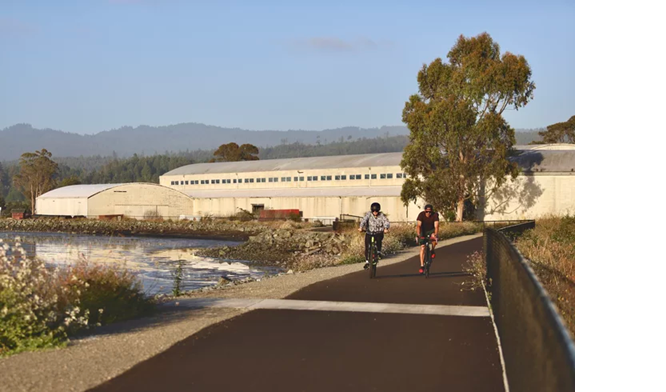
Planned for many years to span the distance between San Francisco and Arcata, the trail is becoming a reality. According to Senator McGuire, about 40% of the trail is either under construction or completed and in use by pedestrians, hikers, and cyclists. The Bay Trail connecting Eureka and Arcata is a good example of that.
Photo courtesy of Andrew Goff
State of the RCAP
Chances look good that the Regional Climate Committee, cornerstone of the county’s Climate Action Plan, will convene before the end of the year. Redwood Coast Energy Authority will provide the all-important nucleus of the RCC with its joint powers board, joined by representatives from Humboldt Transit Authority, Humboldt Waste Management Authority, and Humboldt County Association of Governments to form the full committee. Additionally, a staff member from each jurisdiction and agency will form a Technical Advisory Board. Subject to the Brown Act, the RCC and the TAC will hold public meetings.
This basic structure must be made official with a Memoradum of Understanding between RCEA and all the participating jurisdictions and agencies. The MOU is circulating as RCEA looks to fill two new positions that are required before the RCC will be able to operate. A Director of Engagement and Regional Climate Planning will coordinate climate projects with public outreach and the necessary collaboration between all the different jurisdictions and community organizations. RCEA will fund this position, and the first round of applicants will be reviewed on August 3.
The second position is even more important. The Regional Climate Program Manager. The key word is Manager. I imagine this person will actually have to read the entire Climate Action Plan and come up with a roadmap. To be consistent with the targets set by the RCAP itself, the amount of work to be done in the next three years is staggering. This managerial position will be funded by the county and all the jurisdictions within it. So far Eureka, Arcata, and the county have together budgeted for 85% of the money—enough for the first fiscal year.
Though the smaller cities of the county are citing budgetary constraints, all of them have either adopted the RCAP or plan to soon. A long-term sustainable funding plan will be one of the first orders of business for the RCC and new Director.
Thank you to Beth Burks, Executive Director of RCEA, for furnishing this information.
Happenings
Our general meeting will be held on August 13 at 1:30 at the Arcata Redwood Park near the 14th Street parking lot. (Those driving might want to park in the parking lot on the south end where there is more room.) Don’t forget to bring a chair unless you’re a lot more spry than I am.
Please note: NO Repair Cafe in August. The next one will take place in September.
The Solidarity Gathering on July 13 was well-attended by allies of Friends of the Eel, Climate Action Campaign of Humboldt UU Fellowship, and 350 Humboldt. A strong feeling of engagement reigned after the presentations as attendees shared information about different community issues and events, ranging from the proposed Amazon project to an Alderpoint clean-up action. Several people got up to talk about the importance of holding informal community meetings where different organization came together. We also raised $100 for Flip the Vote, a national organization fervently working to turn out liberal voters in November.
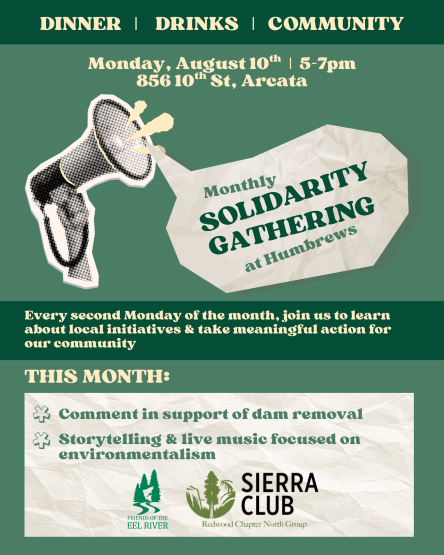
The next Solidarity Gathering at Humbrews [856 10th St. in Arcata] will take place on August 10 at 5 to 7 o’clock. In addition to Friends of the Eel (the organizers of these gatherings), Sierra Club North Group, protectors of our open spaces, will tell stories and perform music. Solidarity gatherings combine the satisfaction of what we believe in with the pleasure of good company, food and drink. Humbrews donates a portion of its sales at the gatherings to the participating organizations.
A political action called Signs of Fascism will take place in Arcata on August 15 at noon. Twenty five signs, each stating a symptom of our country’s slide towards authoritarianism, will be handed out to volunteers on the northwest corner of Foster and Alliance. Sign holders will arrange themselves along the side of Alliance towards Stromberg.
If you would like to hold a sign, please dress in black and show up a few minutes before noon. If all the signs are taken you might sign up to be back-up for someone who can’t stand for an hour. Sign holders might also bring a chair. These actions, which are happening around the country, can make a very sobering impression. If you didn’t already see this video, which was posted in last month’s LookOut, you can view it here.
screenshot from video
A Few of our Favorite Bills
Your legislative committee studies California state bills every year. We advocate for ones that seem most important for the climate, and we oppose the poison pills. As a newby this year, I have learned that the voyage of a bill from introduction in February to possible floor vote in late August is reminiscent of The Odyssey—especially the narrow passage between a six-headed monster (Scylla) and a massive whirlpool (Charybdis) that is famous for eating ships. At each committee stop along the way, our valiant bills can be watered down by corporate shills, compromised fatally, or just put in the deep freeze where it slowly dies.
If a bill somehow survives, more or less intact, all the way to the last committee—Appropriations–do not uncross your fingers. This is where the fate worse than death can happen. Believe it or not, the contents of a bill can be entirely removed and replaced with entirely different text. It’s called Gut and Amend.
Did I mention that this perilous voyage must happen twice for each bill that becomes law? Both houses of the legislature get a whack at it. Assembly bills stagger and duck from committee to committee to Appropriations, and then surviving bills go through the process again in the Senate. Other way around for Senate bills. Once through Appropriations (IF it gets through Appropriations) the Legislature will vote on it. IF passed, then it comes to rest on the governor’s desk. This is not a victory lap because the governor just might veto it after all of that.
Here are a few of our favorite bills that have made it to Appropriations in the second house. One bill for which the odds look good is SB 868—the legalization of plug-in solar panels. These panels can be put anywhere in the sun and plugged into an outlet and voila—solar power. Eight states have already passed a version, so we will be totally disgraced if California doesn’t join their ranks this year.
SB 954 was promised us last year when California passed a sweeping law limiting the necessity of environmental quality review [CEQA] for development. It made some necessary changes but went way too far by exempting a long list of potentially toxic manufacturing processes. Legislators promised to fix that bill with another bill, so here it is. 954 unexempts those processes and revives the most important protections for species habitat. If it doesn’t get gutted and amended in Appropriations and passes the floor vote, will the Governor sign it?
AB 2313 is a cool bill that would make natural gas companies give households the option of going electric instead of having their gas line replaced. The money that the gas company would spend on the replacement would be offered as an electrification incentive instead. Almost a hundred organizations and cities support it. About seven oppose it—mostly gas companies. Any bets?
AB 2461 tightens the bonding requirements for drillers so they can’t so easily abandon their polluting oil and gas wells without cleaning up their mess and capping it. Pray!
Sent via ActionNetwork.org. To update your email address, change your name or address, or to stop receiving emails from 350 Humboldt, please click here.