The
LookOut is a monthly digest of climate-related issues and events
taking place in Humboldt County.
A Place to Stop and
Rest
When it comes to
housing development it doesn’t get any better than the most
recently completed project from the Wiyot Tribe’s Dishgamu
Humboldt Community Land Trust. The Jaroujiji Youth Complex was
designed for young people getting their start in the world. Five
different buildings will provide 31 units for permanent housing, plus
seven units for agency-referred youth in need of temporary shelter.
The complex includes gardens and a sweat house for traditional tribal
activities, a clinic for medical and mental health needs and even a
commercial kitchen.
This socially-minded
project was developed with the climate also in mind. The three main
buildings are renovated older structures. Renovation keeps the carbon
stored in the original buildings, prevents the emissions and waste of
demolition, and minimizes the emissions of construction. The
efficiency of 38 housing units in three already existing buildings
with the addition of two small accessory dwelling units preserved the
surrounding green space.
Jaroujiji, meaning
“a place to stop and rest,” referred
to the Eureka area in the Wiyot language. Jaroujiji Youth Complex is
open to all youth with preference given to tribal applicants. You can
get find a link to an application here.
Transportation Strategies
The good news is that some people have responded to the dizzying
spike in gasoline and diesel prices by taking the bus. They save not
just money but reduce emissions as well. (The bad news, of course, is
the war on Iran that has caused the spike and other much worse
consequences.)
Bus ridership in Humboldt has been climbing since the
epidemic which had caused ridership numbers to crash. Now the numbers
exceed those from 2019. This increase really took off a month after
the war began.
However, most people are still driving. Doing without our me-mobiles
can be difficult if not impossible for many residents of our rural
county. For those folks, I have a message. Slow down. Slowing down to
55 mph can increase your miles per gallon by fifteen percent. Unless
my logic is totally faulty, I’d say that is equivalent to spending
fifteen percent less at the pump.
Think of it like this: You’re in Arcata, needing gas, and across
the street from the Chevron, where gas is $6.45 there is another gas
station that is charging $5.49. Which one would you prefer?
EV drivers are not exempt from the inefficiency of speed. Drive
slower, go further on a charge.
Of course, the blue ribbon goes to the bike riders in our midst: the
hardy, the dauntless, the ones who are not geographically handicapped
when it comes to commuting by bike.
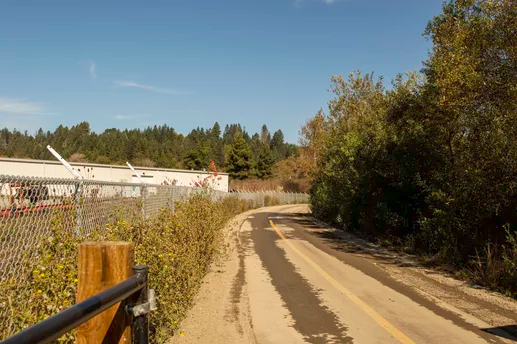
Ride to the River
Very soon bike
riders will be able to travel from the skate park on Sunset Avenue in
Arcata to the Municipal Water District Park 1 on Mad River, a
beautiful recreation spot. We used to get there only by West End
Road, a narrow, curvy road, not well suited for bicycles.
Some finishing
touches are yet to be completed on this newest section of the Annie
and Mary trail, and the official opening ceremony won’t be held
until November 13 (noon at the Foodworks Culinary Center), but all
three and a half miles have been paved. This LOCO article has more details.
More than three
hundred people are already using the trail everyday though a few
bridges are still missing. Construction workers may still be on the
job in places, so weekends are the best time to go the farthest. But
be patient—the trail will be totally finished any day now. The next
phase will take it the rest of the way to Blue Lake.
Dezmond Remington
More Wind
Polling
Residents of coastal
communities up and down the entire western coast are being quizzed
about their attitudes towards the nascent offshore wind industry. How
do attitudes here in Humboldt compare to those elsewhere?
Part of the answer
to that question was conveyed in January of this year by polling conducted by Oregon State University students teamed up with Schatz
Energy Center. According to preliminary results, residents of the
Humboldt Bay area feel more positive about the proposed wind farm and
onshore supportive infrastructure than polled Oregon and Washington
respondents. 379 people in Humboldt participated, and of that number
about twice as many said they were in favor as those who were
opposed. However, the biggest group—44%–was undecided. A more
complete polling picture was supposed to emerge this summer but cut
funding has hampered the project. More results will likely be
available sometime soon.
Meanwhile, results are now in from similar polling conducted in central California
coastal communities—Santa
Barbara, Ventura and other towns. This poll is much larger—more
than 2,000 respondents—and found broad support for the industry.
However, those results were not free of ambiguity either. Even in the
areas closest to the Morro Bay Wind Energy area, many people still
declared themselves to be unfamiliar with the possible development of
wind power.
We don’t need a
poll to tell us that informed people who are concerned about climate
change are most likely to favor the development of wind power. But
before there can be any benefits from the wind turbines themselves,
the onshore support infrastructure must be built first—the proposed
Heavy-Lift Marine Terminal where the turbines will be assembled.
Impacts on
Aquaculture
Both the turbines
and the terminal are going to have impacts on the local ecology of
the bay. This may be of greatest concern for aquaculture.
Schatz Energy Center has been working with aquaculture farmers to
hear their concerns and look for solutions to the inevitable
conflicts. Increased dredging and vessel traffic in the bay pose
dangers to the conditions needed for shellfish—Humboldt Bay plays a
huge role in producing seed for growing oysters–and other
aquaculture. Schatz recently held a webinar to discuss the
potential problems and what might be done in response.
DEIR
Right now a Notice
of Preparation is in effect for the Environmental Impact Report that
must be written for the proposed Heavy Lift Marine Terminal. During
this period of time we are encouraged to submit comments detailing
what we think should be included in the draft EIR. This is called the
scoping process. Click here for an excellent primer on how to
prepare germane comments in response to a Notice of Preparation. The
deadline for comments is December 7. Email them to [email protected]or
snailmail to Chris Mikkelsen at Humboldt Bay Harbor District, PO Box
1030 in Eureka. The zip is 95502-1030
If
in-person commenting is your thing, you have two opportunities coming
up very quickly. A scoping meeting will take place on November 4 at
5:30pm at the Eureka Veterans Memorial Hall [1018 H Street]; and the
second meeting is on November 5 at 5:30pm at the Samoa Cookhouse [908
Vance Avenue]
Harbor District Race
Also
coming up very quickly is the election on Tuesday, and if you live in
Eureka or on the southern Samoa Peninsula, you can probably vote for
the Division 4 seat on the Humboldt Bay Harbor District. One of these
three candidates–Christopher Honar, Jane Madsen, or Craig Benson
will play an important role for wind power and port developments. If any of this is a surprise to you, this article may help.
Happenings
Our general meeting
on November 12 will also be a post-midterms celebration. If the polls
are all wrong and there’s nothing to celebrate, we will
commiserate. Either way there will be cake! Hope to see you at 1:30
at Six Rivers Brewery in McKville at 1300 Central Avenue.
Announcement: 350
Humboldt has a new address—PO Box 325 in Bayside, 95524. You’ll
need this information if you want to send us a donation!
350.org, our parent
organization, publishes a new newsletter, entitled Powered By
You. You can sign up for it here.
Other events
The next Repair Cafe
will take place in Eureka at the Adorni Center (1011 Waterfront
Drive) on Sunday, November 8 from 10am – 2pm. Meet a band of
ingenious volunteers whose idea of a good time is to do their best to
fix your stuff—electronics, small appliances, clothing, jewelry,
etc.–that might otherwise end up in the dump. These people walk
their talk. Please don’t ignore the donation jar unless you are
truly on your last dime.
The next Solidarity
Gathering at Humbrews [856 10th St. in Arcata] will take
place on November 9 at 5 to 7 o’clock. In addition to Friends of
the Eel (the organizers of these gatherings), the Humboldt County
Department of Health & Human Services will be present to teach us
“How to Save a Life!” Learn about administering naloxone, safe
disposal of syringes found at large and harm reduction.
These monthly
community gatherings are a great opportunity to socialize while
learning who is doing what in our community. Humbrews donates a
percentage of their food and drink sales from the event to Friends of
the Eel and the main presenter, so let out the seams a little for a
good cause.
Win Some, Lose Some
The
legislative season is over for 2026. California’s legislators have
toiled for months, fighting word by word over texts, shepherding them
from committee to committee until finally the chosen ones are
presented to the governor who, like God, works in mysterious ways.
One
cruel disappointment was his refusal
to sign AB 2494, a bill sponsored by EPIC and Assemblymember Chris
Rogers. This bill would have upgraded the priorities of California’s
demonstration forests from timber harvesting to sequestering carbon,
biodiversity and scientific studies. Logging would have still been
permitted, but it would have had to fit into those priorities.
Jackson State Demonstration Forest defenders are bitterly
disappointed. But don’t give up. EPIC
has already held a 2494 “debriefing” and a workshop to plan the
next campaign.
Governor
Newsom also vetoed AB 1813, which would have undone some of the
damage done to community solar. Community solar installations can
serve apartment dwellers and other multi-meter establishments, like
schools. Even as California’s rhetoric about affordable clean
energy swells, the assault on distributed solar energy continues.
This article describes the fraught and frustrating history of
community solar since 2022.
That’s
enough bad news for now. For your minimum daily requirement for good news, here are three of the good bills that the
governor signed: The Home Energy Choice Act [AB 2313] lets homeowners
go electric, using funds from their utility that would have gone
towards replacing their gas line. Brilliant.
The
governor passed both SB 913 and SB 905, surprising their
author, Senator Josh Becker. Both of those bills address
affordability and the climate at the same time. SB 905 dares to set
several cost-containment rules, including reining in how much profit
utilities are allowed to collect from certain investments. It also
firmly nudges utilities away from building expensive
infrastructure and towards taking maximum advantage of the resources
already available. Virtual power plants are a good example of this
strategy.
Same
goes for SB 913. It boosts the use of virtual power plants too by
making the CPUC [California Public Utilities Commission] and CAISO
[California Independent System Operator]—two of the entities that
manage the state’s transmission grid–to better measure how much
power can be harnessed and bought from behind customers’ meters.
Though
not a utility favorite, virtual power plants have operated in
California for several years. 905 and 913 pushes utilities and
regulatory agencies to maximize the efficiencies they offer.
Virtual
Power Plants Explained
Virtual
power plants are a shining
example of strategic
distribution.
Decarbonizing our energy supply requires adding clean energy
resources and building infrastructure, yes, but also making the most
out of what we already have. Ingenious
distribution can
go a long way.
VPP
coordinates various household resources—such as solar panels and
batteries, electric vehicles, smart thermostats, and water
heaters—from thousands of households in order to divert their
stored electricity to the grid at the most strategic times. If you
store energy in batteries—including EV batteries–an agreed-upon
amount of that energy may be discharged to the grid when it’s
needed Or your household may deliberately reduce its electricity
use—which has the same effect as making electricity–during a set
period of time by pausing water heating and lowering thermostats
Peak
usage time is the most common occasion for drawing upon these
behind-the-meter resources, but a power supply emergency due to
weather or some other constraint might call for extra juice, or maybe
it’s time to sell when wholesale prices are high.
Though
VPPs have operated in California for years, much of that potential
has been untapped because utilities prefer to build big expensive
power plants which is where the biggest profits are. Governor Newsom
has always declined to push utilities towards maximizing VPP
potential, but this year was different. This year affordability of
electricity was a huge issue for voters, and affordability overlaps
with efficient energy distribution.
Extra Credit Reading
and Listening
Great
Hightower-style editorial about poor billionaires terrorized
by Proposition 40
Supervisor Arroyo
participated in the Week Without Driving, which was sponsored locally
by the Coalition for Responsible Transportation Priorities. Though
she didn’t achieve a perfect score, she managed her busy life
without a car impressively well. Read how she did it here.
Twenty years ago I
thought we nature-loving rural dwellers were living an intrinsically more
environmental lifestyle than decadent urban folks. Oh, the bliss of assumptions. The
climate advantage of living in cities is real—most particularly in
apartments.
The Fifth Climate
Assessment mounted by California offers the deepest dive possible so
far into the impacts of climate change on the state in the
foreseeable future. The Eco-News Report discusses the local picture
with three of the authors of the North Coast Region section.
VOTE
Sent via ActionNetwork.org.
To update your email address, change your name or address, or to stop receiving emails from 350 Humboldt, please click here.